
Hydraulic Industry 4.0 Hydraulic Technology Development Direction and Number of Wisdom Hydraulic
The conceptual scope of hydraulic technology is shown in Figure 1. It consists of four major application fields: energy, automation, transmission, and microfluidics. The automation field is currently the industry's most focused area, as it has the largest market share. Further attention should be paid to other fields, and the correlation between hydraulic technology and digital networking and intelligence in these fields is also expressed in Figure 1.
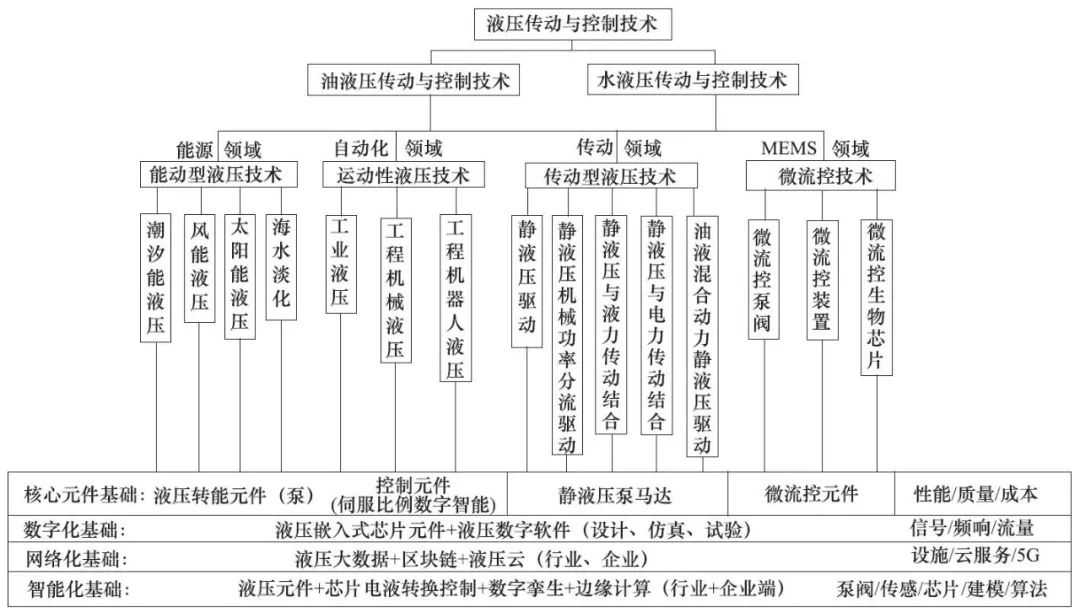
Figure 1 Hydraulic technology consists of four major
application fields: energy, automation, transmission, and microfluidic control
The Development Direction of Hydraulic Technology in the Next Decade
The future of hydraulic technology development can be summarized as "three energy and one water", namely "energy generation, energy conservation, intelligence, and water hydraulics". This article focuses on the development of digital intelligent hydraulic technology under Industry 4.0, and summarizes the main directions and paths of hydraulic development in the next 10 years from three dimensions. The direction, driving force, means and measures, performance improvement, and benefits of each dimension are described, and all are combined with social needs and application fields (Table 1).
Table 1 Development Direction of the Hydraulic Industry (Fluid Transmission and Control) in the Next 10 Years.
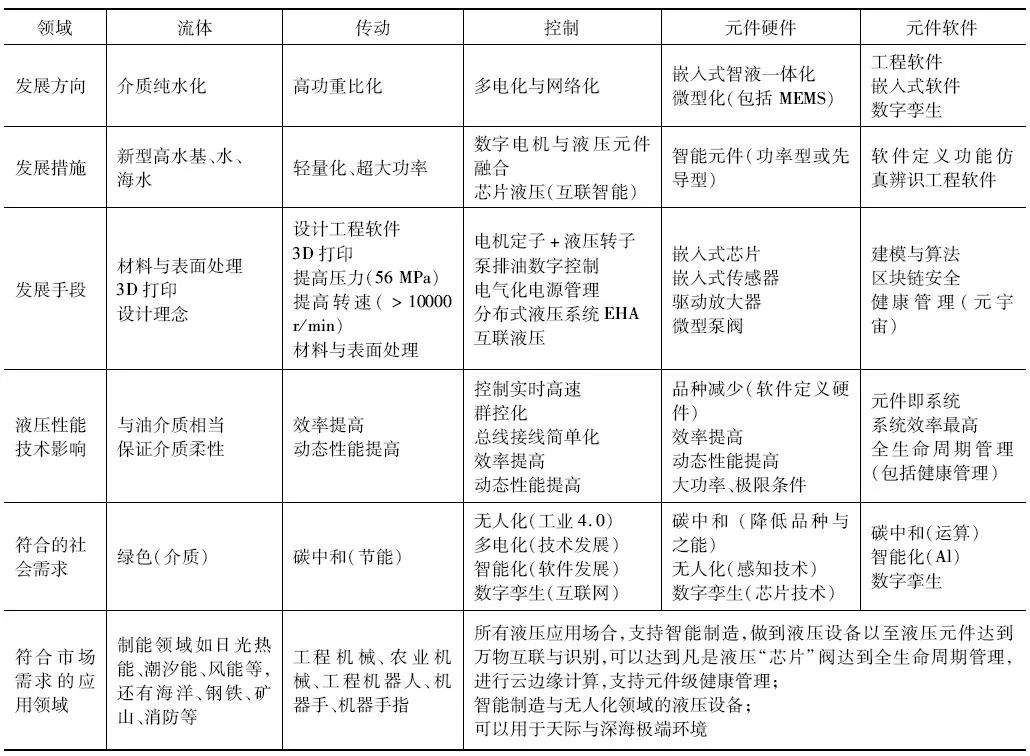
(1) Analyzing hydraulic technology from the perspective of the discipline of "fluid transmission and control" can be distinguished from four aspects: fluid medium, transmission field, control field, and component product field.
(2) Predict hydraulic technology from the dimensions of social demand and market driving force. The fundamental driving force of hydraulic development lies in the following five aspects: carbon neutrality, unmanned, multi electrification, digital twins and green ecology.
(3) Reflect the development of hydraulic technology from the perspective of application needs, and combine it with the technological development of Industry 4.0 era to concretize this development direction.
Hydraulic pressure must maintain irreplaceable advantages in the three major transmission and control systems
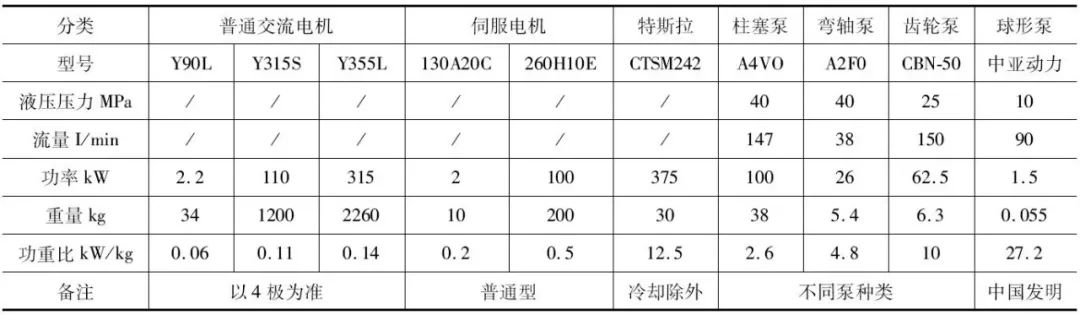
Compared to "electrical transmission and control" and "mechanical transmission and control", hydraulic technology has three major advantages: high power to weight ratio, high dynamic response, and flexible media. High power to weight ratio is the biggest characteristic of hydraulic system, combined with linear actuator, which constitutes the main strength of hydraulic system (Figure 2, Table 2). High dynamic response is derived from the advantage of high power to weight ratio. In sports hydraulic control systems, especially at high power, the hydraulic dynamic response can be in the range of several to tens of milliseconds, which is at least one order of magnitude higher than other transmissions. The flexibility of the medium has become a unique feature of other technologies due to the rise of robot applications. These advantages sometimes lead to the return of certain electrification to hydraulics.
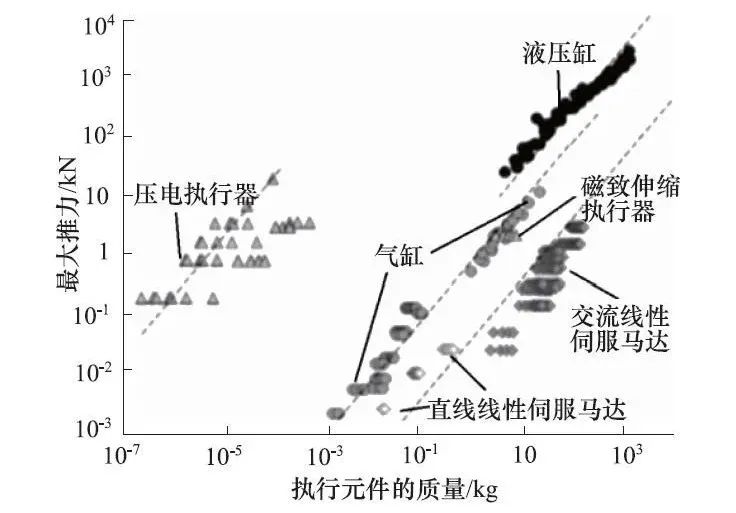
Figure 2 Comparison of hydraulic linear actuator with other technologies
Table 2 Comparison of power to weight ratio between hydraulic and electric motors
The three weaknesses of hydraulic system are the reasons for its replacement: firstly, low efficiency. With the improvement of the power to weight ratio of electric transmission and high efficiency, it has become the biggest challenge that the hydraulic industry must face in the future. The second is that the medium is not green, and the pollution of the medium will affect the environment for human survival. The third weakness is that the pipeline lines are long, inconvenient and unsafe, which can easily cause faults and become the driving force for electrical replacement, such as the multi electrification of airplanes. Especially in the past year or two, due to the popularity of Tesla permanent magnet synchronous motors and the rapid development of domestic electric engineering machinery, this challenge has been manifested in market applications and caused widespread anxiety in the industry.
The countermeasures for hydraulic pressure to face this challenge are: firstly, to integrate the hydraulic pump and motor into one, that is, to integrate the hydraulic rotating part with the motor rotor, fully absorbing the advantages of the development of permanent magnet motors; The second is to "combine" the motor and hydraulic pump into a multi electrified motor pump, equipped with internet communication, and equipped with a bus type hydraulic distributed digital power actuator (EHA); The third point is to increase the working pressure of the hydraulic pump to 56MPa and the speed exceeds 10000r/min, which is set based on the technical feasibility and economic feasibility; The fourth is the advantage of hydraulic reinforcement in the field of high-power to ultra high-power; The fifth is to make lightweight efforts in design, materials and surface treatment, process processing (3D printing), and other aspects. Hydraulic miniaturization is one of the effective ways, as evidenced by the invention of the spherical pump in China.
There is no consensus on whether hydraulic power is a sunset or sunrise industry. Only by leveraging the fundamental advantages of technology through innovation can the integration of hydraulic power and electrification be an accessible solution. Secondly, the flexibility of hydraulic media is an advantage in the field of sports, with Boston DOG transitioning from electric transmission to hydraulic transmission; Thirdly, the advantage of hydraulic power to weight ratio has led to the return of hydraulic servo after years of electrification; Fourth, new industries can be derived from the development of hydraulic spherical pumps in the field of the universe, mechanical fingers, and carbon neutrality cooling compressors. For China, high-end hydraulic technology is an "emerging industry" because the "bottleneck" issue has made us realize that our country's major projects and equipment require the support of hydraulic technology, from aerospace, deepsea, mining, engineering equipment, and plastic machinery. There is still great room for the development of hydraulic applications. In the scope shown in Figure 1, there are some areas that we currently lack attention to, and there is still room for development.
Our conclusion is that the hydraulic industry is not a sunset industry, its high-end is a sunrise industry! Hydraulic pressure has room for development and a market for development. But the electrical challenge has already posed a threat, and this threat is developing into an impact. Therefore, the hydraulic industry must strengthen innovation in order to develop new opportunities in the face of difficulties!
At present, hydraulic technology is hesitant to move forward in the face of the great opportunities of electrohydraulic integration and intelligent hydraulic integration. The reason for this is that although the social needs and development are clear, the macro trend is a slow process and often fails to trigger the reality of microeconomics benefits. It's like a situation where "boiling a frog in warm water" is trapped and difficult to wake up. But once you see the trend clearly, you will be more proactive in promoting the development of applications. Not only does it reflect the difficulty of technical measures to improve the power to weight ratio, but there are also many difficulties in market acceptance. This also indicates the need for breakthroughs in this area.
Digital hydraulic system is the "chip based" hydraulic component
3.1 The future direction of hydraulics lies in carbon neutrality, unmanned, multi electrification and digital twin social needs
The development of any technology depends on the demand of the market, which is guided by the overall demand of society. Therefore, the source of hydraulic demand is the strategic demand of society, which is carbon neutrality, unmanned, multi electrified and digital twin!Carbon neutrality is the cornerstone of human survival, and is protected from irreversible damage to the ecological environment. As the hydraulic transmission technology with the lowest efficiency, it is a pain point. The essence of hydraulic control technology is a damping system that consumes energy. In order to reduce the impact of damping in control, a series of energy-saving technologies such as variable displacement pumps, hydrostatic pressure, and secondary speed regulation have been adopted. The future solution should be to reduce the participation of hydraulic control itself, adopt the perception and calculation functions of microprocessors, and achieve real-time consistency between the required energy and the provided energy, thus achieving the highest possible efficiency.
Unmanned technology is currently a hot topic in the development of social productivity, and an intelligent society with unmanned driving or unmanned factory management is coming. The requirement for an unmanned host is not only for the system to have intelligence, but also for the component level to have intelligence in order to achieve the level of "Internet of Things" and implement full lifecycle management of hydraulic components. This requires us to achieve intelligence at the component level.
The trend of hydraulic multi electrification is faster than expected, and both hybrid and pure electric drives can already enter engineering implementation. Multi electrification will undoubtedly benefit the needs of unmanned and carbon neutrality. The added power management link will be beneficial to energy storage and management, increase the efficiency of the hydraulic system, and have a positive impact on carbon neutrality. And these are also inseparable from the intelligence of the components.
Digital twins refer to the closed-loop system of digital data in the Internet. Create physical entity through digital simulation of computer virtual world; The data generated by the operation of physical entity can be fed back to the original digital terminal to generate mapping and correction. Digital twins are becoming the core value of internet applications, a technology that enables full lifecycle management of any component. And this technology will be a breakthrough in the health management technology of hydraulic components. It is worth mentioning that the metaverse is still in development, which may become a new industry for maintenance, training, education, on-site fault handling, etc.
According to the above requirements for the survival and development of human society, the development direction of hydraulic technology all points to one demand, that is, the intelligence of computers: carbon neutrality requires hydraulic components or system intelligence to sense the energy demand, to provide calculation with minimum loss and pay as needed, to achieve the required maximum efficiency; The intelligence of hydraulic components or systems used for unmanned or multi electrified systems meets the control and health management needs required in scenarios, achieving the role of internal control and health management in unmanned systems; The hydraulic digital twin is a product of the computer virtual world, combined with communication technology to achieve the goal of full lifecycle management of hydraulic products. All of this indicates that hydraulic components need to be integrated with computers, such as microprocessors, to form a chip embedded hydraulic component called "chip hydraulic" products, which is also known as digital hydraulic.
3.2 Digital Hydraulic is the Pioneer of Digital Intelligence Hydraulic
Digital hydraulic "is a product of the era of industrial 3.0 electrohydraulic integration, with a focus on new hydraulic digital components. The highlight is the" non analog control "electrohydraulic conversion components and their hydraulic components, such as stepper/servo motors, high-speed on-off valves, valve islands, and so on. Its variety and system are shown in Figure 3.
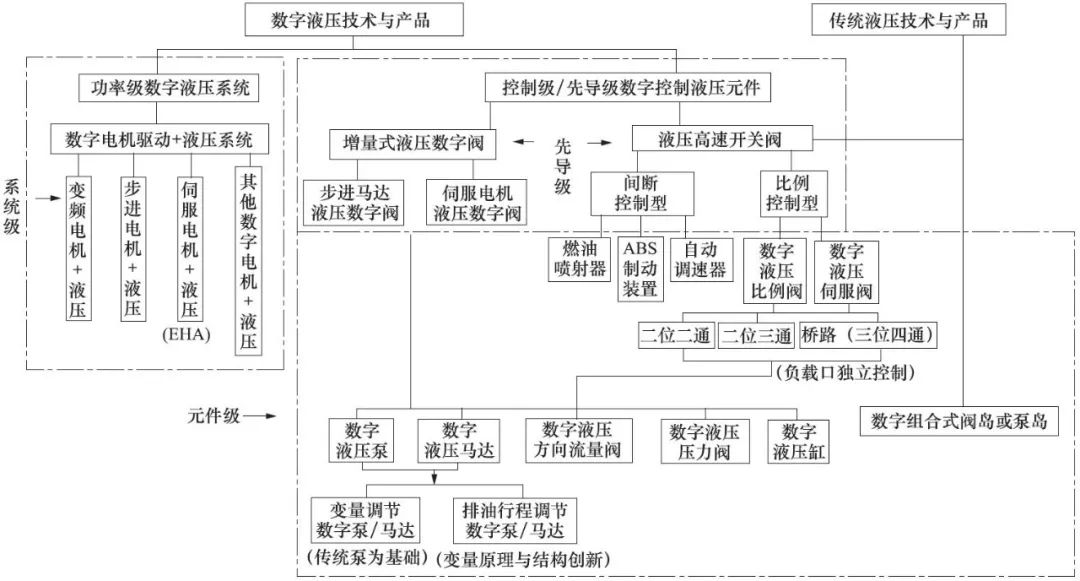
Figure 3 Types and Systems of Digital Hydraulic Products
Microprocessors have been adopted in the development stage of digital hydraulic systems, but they are not the focus. At this point, the focus is on the performance of the digital hydraulic components themselves, such as the PWM digitization of the input signal of the components, whether the output is discrete, and whether the components are analog controlled. With the clear proposal of Industry 4.0, unmanned and other social needs have made intelligence an inevitable choice for our technological development. Network connectivity and software functions are an integral part of it, and digital hydraulic components have only developed into digital intelligent hydraulic components. This development process is traditional hydraulic (analog control hydraulic) - digital hydraulic (non analog control hydraulic) - digital intelligent hydraulic (embedded chip hydraulic components), as shown in Figure 4.
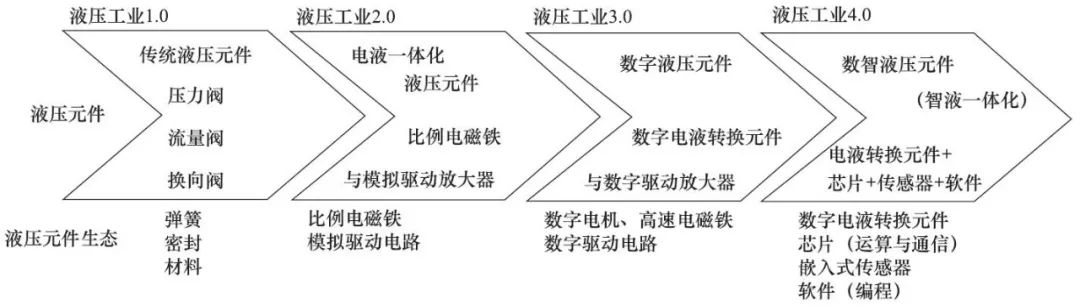
Figure 4 Development Stage of Hydraulic Components
3.3 Prototype of hydraulic intelligent components
The DanfossCMA proportional multi way valve product is a pioneering and preliminary intelligent hydraulic component (Figure 5). Its sample claims to have three major revolutions. Figure 3 shows the types and systems of digital hydraulic products. Figure 4 shows the phased development of hydraulic components: independent load ports, reaching the current maximum pressure of 44 MPa, and centered pilot valve cores. In the author's opinion, its three major revolutionaries lie in: intelligent processing with load sensitive circuits, where software completes load sensitive saturation processing, which is original; The second is the introduction of an unprecedented embedded sputtering pressure sensor; The third is the bold adoption of a linear motor (voice coil motor) that has been forgotten by hydraulic pressure. However, this product does not address the issue of health management in intelligence. The independent load port naturally exists as long as digital hydraulic components are used, which is an innovation and progress in the market selling point and indeed something that products in the past did not have.
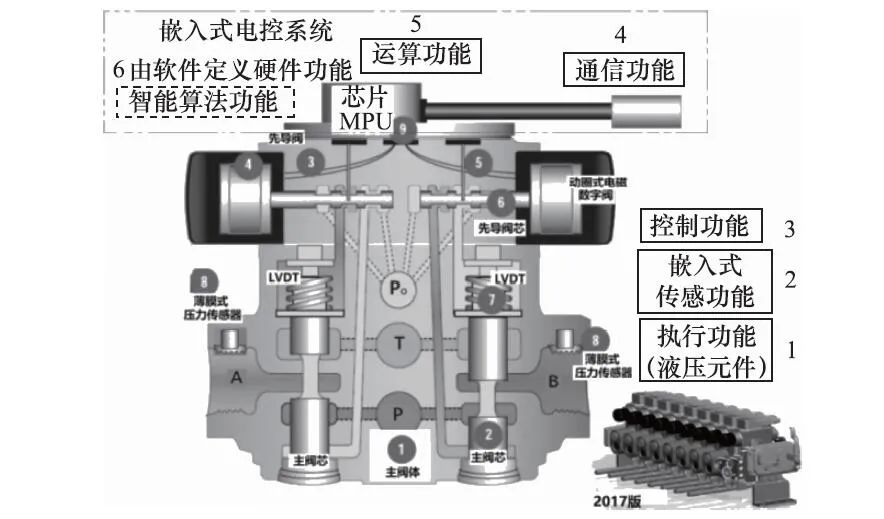
Figure 5 Prototype of Hydraulic Intelligent Components (Danfoss CMA Proportional Multiway Valve)
From Figure 5, it can be seen that the CMA proportional valve with preliminary mathematical intelligence possesses all the hardware and software elements of intelligent hydraulic components, including the execution function of the hydraulic components themselves, the cognitive function of embedded sensors, the operation function of microprocessors (MPUs), control drive amplification function, and internal programming algorithm function. The integration of the last three functional boards becomes an embedded digital electronic control system.
The superiority of digital hydraulic system is reflected in: the chip (microprocessor) is the hardware core of hydraulic components, which determines the function and performance of the components; The function of software defined components is the core; Sensors have sensing function, which is the foundation of information input and the basis for software calculations; According to the variety and specifications of hydraulic control components mentioned above, there will be a sharp decrease, which is conducive to the automation and intelligence of enterprise manufacturing; Implement full lifecycle management of components; Efficiency management and health management have a developable foundation; It can realize the direct use of cloud ecology, including big data, blockchain, edge computing, etc.
3.4 Good Development and Difficulties of World Digital Intelligence Hydraulic Products
Overall, the digital hydraulic products are in the stage of innovation exploration and market promotion, and have also achieved initial results. Based on the above, we will first summarize them in Table 3.
Table 3 Comparison between Current Famous Hydraulic
Companies and China in the Field of Digital Intelligence Hydraulic
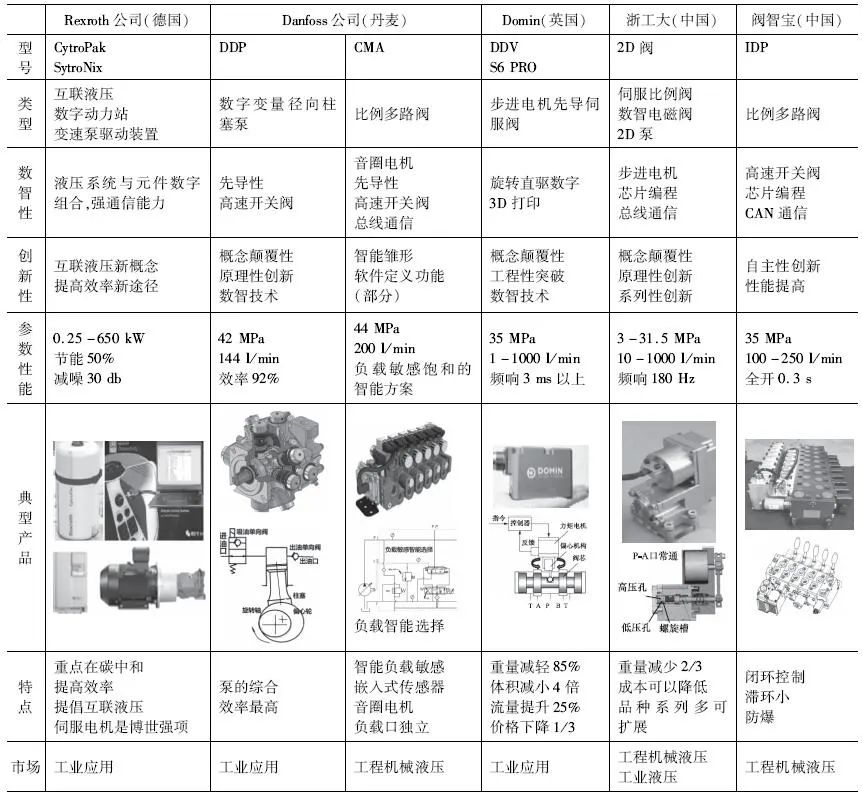
The representative digital intelligent hydraulic components expressed in Table 3 provide us with some insights:
(1) Hydraulic technology has entered the era of digital intelligence technology development. Continuously breaking the traditional concept of hydraulic components for hydraulic pumps, hydraulic proportional valves, and even the top servo valves.
(2) The innovative points are to minimize the effect of hydraulic damping on the power end and reflect the execution function of the hydraulic system.
(3) All innovative components are concentrated in the electro-hydraulic conversion device from a hardware perspective, whether in the power stage or the pilot stage .
(4) All innovative components are controlled by microprocessors (chips), and their intelligence has not yet been fully realized, requiring further research and development in both fundamental and engineering aspects.
(5) The goals of digital intelligence hydraulic innovation are focused, including carbon neutrality, improvement of motion control performance, customization of digital intelligence components and cost benefit.
(6) The characteristics of digital intelligent hydraulic systems of various enterprises are different: Rexroth uses its own servo motor characteristics to develop interconnected hydraulic systems, which is prominent in the power stage intelligent hydraulic systems, directly benefiting carbon neutrality; Danfoss's hydraulic digital intelligence technology clearly adopts pilot level digital components, such as high-speed on-off valve technology, which fully utilizes the advantages of digital motors; Other original digital intelligent hydraulic components, including those from China, are led by stepper motors, which have advantages in cost and production, and have relatively low difficulty coefficients.
(7) Numerical control hydraulic simulation components, such as the original Eaton AxisPro, are also a way to develop digital intelligent hydraulic components.
At present, there are many difficulties in the promotion and application of digital hydraulic products:
(1) The digital intelligent unmanned hydraulic host is still solving the external performance such as external road identification, and the requirements for internal hydraulic pressure have not been in-depth and clear. Therefore, the upstream and downstream are in a stage of mutual
promotion and waiting.
(2) Digital hydraulic products have entered the market, lacking the coordination of the entire system and the upstream and downstream ecological environment. It's the pain during childbirth. It cannot meet the batch requirements of upstream, nor can it make the user experience perfect at once.
(3) Limitations on user talent. Hydraulic control is not fully mastered, and programming is unfamiliar and ignorant. Education and training are a soft power.
The Road to a Strong Country in China's Hydraulic Industry: "Dry and Powerful"
Rexroth, Danfoss, Parker, Moog, and Kawasaki have strong brand effects in the minds of Chinese people, which will translate into advantages in expanding the market. In the 1980s, we introduced the technology of "market for technology" and achieved the "world number one" in today's medium to low end hydraulic system; The 2009 "China Equipment Manufacturing Industry Adjustment and Revitalization Plan" policy reflects a greater emphasis on basic components. With Hengli as the symbol, the concentration ratio of China's hydraulic industry has reached more than 20%, and Aidi Precision, Chuanrun, Shaoyang Hydraulic, Weibo Hydraulic, Weichai Linde, Taifeng Hydraulic, etc. have been listed or are ready to be listed, with a strong development momentum. However, the concentration ratio of the hydraulic industry is still less than 30%, the "small, scattered, poor" has not changed to a fundamental level, and the gap with foreign multinational enterprises is still obvious. The fundamentals of China's hydraulic industry are still in the industrial 2.0 stage, and we need to strengthen the basic issues including quality, batch size, and brand. We know that in the digital hydraulic era of Industry 4.0, it is a rare opportunity for China's hydraulic industry to develop into a strong hydraulic power. But what route is used?
4.1 Achieving a strong hydraulic power through the path of "high-end digital intelligence technology to enhance low-end hydraulic components"
The approach of achieving a strong hydraulic power through "high-end digital intelligence technology to enhance low-end hydraulic components" is to surround the high-end with low-end technology, similar to the strategy of surrounding cities in rural areas in the past. It is most in line with China's national conditions, first popularized, and then entered the costly high-end field.
Over the past 40 years of reform and opening up, China's hydraulic industry has also accumulated its own innovation. The achievement of "Key Technologies and Applications of Two Dimensional (2D) Electrohydraulic Flow Servo Valves" led by Professor Ruan Jian from Zhejiang University of Technology, which won the first prize of China Machinery Industry Technology Invention in 2020, is a clear proof! In addition, there are many kinds of innovations, including: the hydraulic stepping rotary valve cooperated by Liaoning University of Technology and Liaoning Haiyu Fluid Transmission System Co., Ltd., the hydraulic numerical control rotary core multi way valve of Wuhan Hannuo Electric Control Co., Ltd., the hydraulic micro spherical pump of Shenzhen Zhongya Power (which can be used in the subversive robot finger scene), the high-speed on-off proportional multi way valve of Chengdu Valve Zhibao, the double end oil inlet plunger pump of Yanshan University, Yimeibo's stepper digital cylinder and derivative hydraulic components, Shanghai Jiaotong University's dual servo control digital cylinder, Shanghai Shangxi's hydraulic servo digital cylinder for spinning machines, Hangzhou Libei's CNC analog proportional valve, Guiyang Mangwei Fluid Intelligence Technology's CNC high-speed switch continuous proportional control valve, Jilin University's collaboration with Guangdong Fuhua Heavy Industry's array digital pump (pump island) for engineering machinery, and so on. One obvious feature of these hydraulic components related to digital/digital intelligent hydraulic systems is that most technical solutions are relatively simple and feasible, and some have a 4.0 intelligent prototype.
Based on the above national conditions, the following suggestions are made for the development of Digital Intelligence Hydraulic:
(1) Vigorously develop and support the marketization of digital intelligent hydraulic components with Chinese characteristics, especially the hydraulic 2D valves and other digital intelligent hydraulic components that have been tested in the market, especially the EHA products required for the developing intelligent handling vehicle AGV.
(2) The digitization of low-end hydraulic components (such as ordinary directional valves) can reduce the variety of hydraulic components used in ordinary hydraulic systems (which can be controlled at multiple points), increase their functions, and simplify the hydraulic system.
This can reduce the cost and increase the reliability of the hydraulic system. It can be immediately connected to bus control, simplify PLC control, simplify electrical control wiring, and also achieve bus control, Enable hydraulic users in China to immediately enjoy the practical benefits brought by digital/intelligent hydraulic technology, thereby generating the popularization effect of industry application digitization, networking, and intelligence. By applying high-end technology to low-end products to occupy the hydraulic market from this perspective, avoiding asymmetric competition with multinational corporations, we aim to achieve widespread influence and even catch up.
(3) One of the conditions for introducing high-end technology and promoting low-end components is that the cost must be sufficiently lo w for users to bewilling to adopt them, and in order to gain significant experience and produce rapid promotion effects. The practice of Letu hydraulic stepping chip valve has given us inspiration. The digitization of CY pump variables that we are currently working on is an effort in this area.
(4) The high-end development of low- end components can help China's hydraulic market quickly digitize, cultivate the talent advantages of digital hydraulic,and increase financing channels for investors to see the development prospects of digital hydraulic, rather than just seeking government project funding as a single bridge.
4.2 Need to sit and talk, but more importantly, do and walk
On the basis of its own development, hydraulic enterprises can rely on national policy funds, listing and project funds, integration of upstream and downstream supply chain resources, and vertical and horizontal linkage of small and medium-sized enterprises to obtain better
resources for development. Make full use of the strong strength and achievements of hydraulic colleges to strengthen cooperation between industry, academia, and research, solidify technology into products, and achieve greater development. Therefore, it is recommended to establish a discussion mechanism and docking mechanism for the development of the hydraulic industry, guide investment direction, and facilitate the self renewal of the hydraulic industry.
The Shanghai Hydraulic and Pneumatic Sealing Industry Association has held the second "Hydraulic and Pneumatic Intelligent Enterprise Forum" to promote the exchange of hydraulic digital intelligent product development and intelligent manufacturing. Six digital hydraulic docking promotion teams have been formed to track and assist for years, including hydraulic stepper digital intelligent chip valves, hydraulic EHA, construction robots, intelligent manufacturing, digital hydraulic testing technology, and hydraulic digital intelligent component detection and testing standards. The Radio and Television Metrology, supported by the Ministry of Industry and Information Technology and responsible for establishing a hydraulic public service platform, has played a positive role in promoting the operation. And organize specialized seminars on digital hydraulic technology with the Society of Mechanics, Radio and Television Metrology, and other organizations to promote the development of digital hydraulic technology and products. Hydraulic Industry 4.0 provides an open path and opportunity for the development of hydraulic technology, with the guiding ideology of "hydraulic intelligent manufacturing produces digital intelligent hydraulic components, and uses hydraulic digital intelligent components to promote the intelligent equipment required for hydraulic intelligent manufacturing and unmanned equipment", making China's hydraulic industry stand in the forest of strength!