
The design process of hydraulic components
1. Determine market direction
Hydraulic components, generally speaking, are universal and their functions are available everywhere. So, when enterprises produce hydraulic components, they often do not have clear and fixed customers and application scenarios. But the first thing to determine is which market to target.
Pre market refers to providing to host manufacturers for use on new hosts. The product design for the previous market is relatively more flexible, especially since the main engine is still in the trial production stage, allowing for significant changes in hydraulic components.
Generally speaking, the quantity ordered in each batch is relatively large, and high performance consistency and work durability are desired.
Post market refers to supplying end customers as replacement parts. Generally, the quantity of each batch is not large, and the requirements for performance consistency and work durability are lower than those of the previous market. There are often more stringent requirements for prices. However, due to the low threshold, it is often chosen by enterprises as a starting point.
2. Conduct research on the status of existing products and customer needs
Understand the prices of the market (competitors), current manufacturing costs, demand, potential orders, and development trends to determine whether it is worth developing. Although these are mainly tasks for the marketing and sales departments, designers should also be very clear about them, as they have a significant impact on their future work.
Not only should we understand the customer's current expectations, but we should also know their expectations from yesterday and imagine their expectations for tomorrow. Smartphones are designed to quickly eliminate traditional phones in a short period of time, as designers have come up with expectations that customers have not yet expressed clearly and hit the nail on the head.
3. Determine the performance that the target product should achieve
Designers should comprehensively, accurately, clearly, in writing, clearly, and in detail state the performance that the target product should achieve. The process of expression is also a process of deepening the understanding of product performance.
There are corresponding industry standards in China for the performance requirements of most hydraulic components. But it should be recognized that industry standards should only be considered as minimum requirements.
4. Surveying samples
A lot of work for designers in the mechanical industry is to improve existing products, with very few starting from scratch.
Surveying the structure and dimensions of existing products for imitation, also known as reverse engineering, is currently being carried out by most hydraulic component manufacturers in China.
After hundreds of years of continuous research and development, modern hydraulic technology has become quite mature, and high-end products have a high level of high-tech content. At present, many hydraulic products in China still have a considerable gap from the world's advanced level. To quickly catch up with the world's advanced level and develop new products, starting from surveying and mapping imitation without patent protection for corresponding products or technologies can be a favorable starting point. Surveying and mapping imitation, as long as it does not infringe on patents, is still a common occurrence even in advanced industrial countries in Europe and America.
However, it must be recognized that the hydraulic performance can not be guaranteed to be identical by surveying and mapping imitation. The reasons are as follows.
1) The measurement of geometric dimensions is generally carried out at room temperature and normal pressure, and the deformation that occurs during the actual operation of components under high temperature and pressure cannot be measured.
2) Modern hydraulic components often have some subtle changes in size and shape to meet the needs of working under high pressure and high speed.
For example, in order to improve volumetric efficiency, some manufacturers have machined a slight curvature at both ends of the cylindrical plunger of the swash plate plunger pump (see Figure 13-1) to increase the sealing area of the plunger when subjected to tilting force. The dimensions at both ends are only a few tens of thousands of times smaller than those in the middle. If you don't know the principle of action, you can't even think of testing it.
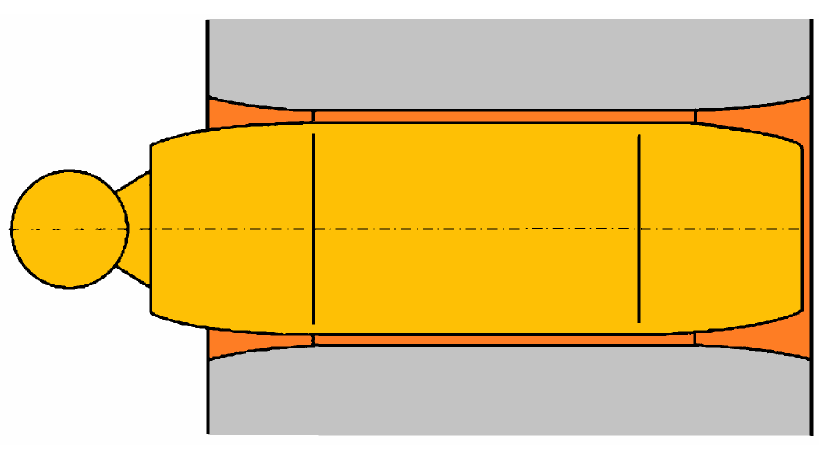
Figure 1: The pre machined curvature of the plunger and cylinder body of the swash plate plunger pump
3) Surveying can only measure the dimensions of a limited number of samples, and cannot determine the allowable machining deviation.
4) Merely measuring the geometric dimensions cannot fully grasp the characteristics of the sample. For example, the composition of materials, impurity air content, heat treatment, and metallographic structure have a significant impact on the performance of hydraulic components, especially pressure resistance and durability.
5) The so-called Industrial Revolution 4.0, proposed by three German professors in 2013 and supported by the German government and responded by numerous businesses, aims to use modern means to meet the personalized needs of customers at low cost and fastest. Therefore, the update speed of advanced products will become faster and new products will emerge one after another. The result is that I don't know which one to imitate, so I don't have time to copy.
So, while measuring the geometric dimensions of the sample, it is even more important to think hard and understand its working principle. We also need to test its hydraulic performance as a benchmark for imitation.
5. Design Prototype
After surveying and mapping, we should consider improving and innovating according to the actual situation, for the following reasons.
1) Merely surveying and imitating can only keep up with others. Without improvement and innovation, there will never be independent intellectual property rights.
2) What the patent restricts is just the same copying. If improvements can be made on its basis, not only will it not be restricted by the original patent, but it can also apply for new patent protection.
3) The products at the world's advanced level are also constantly improving. Why say that the sample used as the object of imitation is flawless and must be imitated, and cannot be further improved or surpassed?
So, surveying and mapping imitation can only be the starting point of research and development, and should not be the end point of research and development.
When designing a prototype, it is necessary to analyze and determine the materials, heat treatment processes, allowable machining deviations, and surface roughness of each component, and discuss the possibility of machining with the process engineer. The machining requirements for components cannot be arbitrarily determined: if a deviation of ± 0.05mm and ± 0.01mm is allowed, the machining cost will be several times higher if there is only a one word difference.